Fabry disease: TIGEM’s contribution to research
April is the month dedicated to raising awareness of Fabry disease, a rare genetic disorder belonging to the group of lysosomal storage disorders (LDSs). These disorders are caused by altered lysosomal function. Lysosomes are essential cellular organelles responsible for the breakdown of various biological macromolecules, including sphingolipids.
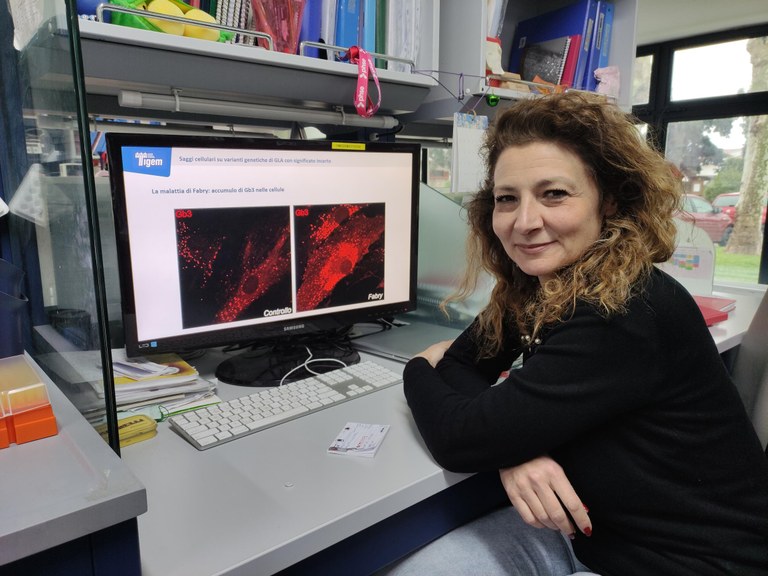
For years, the TIGEM research group led by Antonella De Matteis, with the contribution of Laura Giaquinto and in collaboration with clinician Giancarlo Parenti, has been engaged in studying the cellular mechanisms underlying the disease. In Fabry disease, the total or partial deficiency of the lysosomal enzyme alpha-galactosidase A impairs the breakdown of globotriaosylceramide (Gb3), leading to its progressive accumulation in lysosomes.
“When alpha-galactosidase A is defective or absent, Gb3 accumulates in lysosomes, causing widespread damage that can affect multiple organs and systems” explains Laura Giaquinto. The enzyme is encoded by the GLA gene, located on the X chromosome, and more than 1,000 variants have been identified so far, highlighting the high molecular heterogeneity of the disease.
“Mutations in the GLA gene can reduce or abolish enzymatic activity, with highly variable clinical consequences” adds Giaquinto. “Variants associated with complete loss of function generally cause severe, multisystemic forms of the disease, while those preserving residual activity are more often linked to later-onset forms and milder phenotypes.”
The therapeutic options currently available still have significant limitations. Enzyme replacement therapy (ERT) has been available for years and has represented a major advance in the clinical management of patients, helping to slow disease progression. However, its effectiveness can vary and does not always fully prevent long-term organ damage. In light of these challenges, TIGEM’s research continues to play a fundamental role, with the aim of developing more effective and targeted therapeutic strategies.
TIGEM’s commitment to the study of Fabry disease
Research activities on Fabry disease at TIGEM began in 2012 thanks to significant funding from the pharmaceutical company Shire, now Takeda. Since then, studies have developed along two main lines: on the one hand, the identification of molecules, drugs, or siRNAs capable of reducing Gb3 accumulation; on the other, the study of Substrate Reduction Therapy (SRT) strategies aimed at limiting substrate synthesis by targeting the enzymes involved in its production.
“These studies have allowed us to significantly deepen our understanding of the biological mechanisms underlying the disease” explains Giaquinto. “Although they did not lead to an immediate therapeutic application, they represented an essential step for basic research, providing useful elements for the development of new lines of investigation.”
In 2022, thanks to further funding obtained through the Telethon Foundation’s Seed Grant, the group led by De Matteis launched the project Cellular assays on genetic variants of uncertain significance (VUS) in GLA, aimed at clarifying the role of specific alpha-galactosidase A variants whose clinical significance has not yet been defined.
As part of this project, innovative cellular assays were developed to directly assess both enzyme activity and its correct lysosomal localization in patients’ cells, overcoming some limitations of the methods traditionally used. The study also included comparisons between individuals from the same family carrying the same VUS variant.
“The results suggest that the clinical impact of some variants of uncertain significance may be influenced by an individual’s genetic background” comments Giaquinto. “This finding may help explain the phenotypic variability observed even among subjects belonging to the same family.”
New research perspectives
Starting in 2025, Antonella De Matteis’ group expanded the study of VUS through an internal collaboration focused on identifying hyperactive enzymes. This is a multidisciplinary approach integrating bioinformatics, computational biology, and cell biology.
In this context, artificial intelligence framework developed by Andrea Pasquadibisceglie and Gennaro Gambardella is being used to predict point mutations potentially capable of increasing the catalytic activity of alpha-galactosidase A, while functional analysis in cellular systems makes it possible to experimentally validate the selected variants.
“The goal is to develop super-enzymes that are more effective than the wild-type form, with the potential to improve the effectiveness of enzyme replacement therapy and provide a basis for future gene therapy approaches” concludes Giaquinto. “An increase in enzymatic activity could in fact translate into more targeted therapeutic strategies and, potentially, greater clinical benefit for patients.”
The research conducted at TIGEM on Fabry disease confirms the importance of integrating basic research and methodological innovation in order to deepen our understanding of disease mechanisms and open new perspectives toward more effective and personalized therapeutic strategies.