
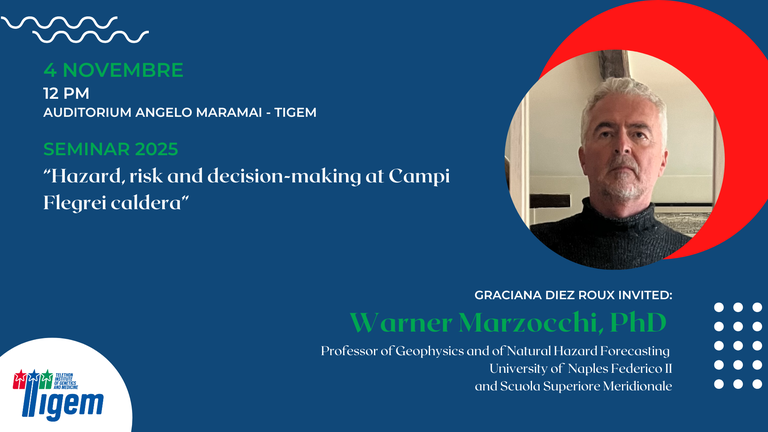
Warner Marzocchi, PhD - "Hazard, risk and decision-making at Campi Flegrei caldera"
- When Nov 04, 2025 from 04:00 PM to 05:00 PM (Europe/Berlin / UTC100)
- Where Tigem Auditorium Angelo Maramai
- Contact Name Graciana Diez Roux
- Contact Phone 08119230659
-
Add event to calendar
 iCal
iCal
- https://www.tigem.it/newsroom/seminars/warner-marzocchi-phd-hazard-risk-and-decision-making-at-campi-flegrei-caldera
- Warner Marzocchi, PhD - "Hazard, risk and decision-making at Campi Flegrei caldera"
- 2025-11-04T16:00:00+01:00
- 2025-11-04T17:00:00+01:00
Warner Marzocchi, PhD
Professor of Geophysics and of Natural Hazard Forecasting
University of Naples Federico II and
Scuola Superiore Meridionale
Short CV
Abstract
Campi Flegrei caldera (CFc) is an active volcanic field that directly threatens several hundred thousand residents within the caldera and more than a million people in nearby Naples, who could be severely impacted by heavy ashfall and pyroclastic flows in the event of an eruption. The volcano, throughout its history, has produced a very wide range of eruption sizes, from small monogenic events such as Monte Nuovo (1536 AD) to large caldera-forming eruptions such as the Campanian Ignimbrite (CI; about 40,000 years ago) and the Neapolitan Yellow Tuff (NYT; about 15,000 years ago). This enormous variability, coupled with the lack of a clear correlation between precursor signals and the size of eruptions, makes it difficult to forecast not only the onset of an eruption, but also how large it might be. The most recent CFc eruption (1538) was preceded by decades of unrest marked by caldera-floor uplift, seismic swarms, and changes in fumarolic activity. After centuries of apparent quiescence, activity resumed with four unrest episodes over the past 70 years: 1950–1952, 1969–1972, 1982–1984, and 2005–present. Each episode featured heightened seismicity and uplift concentrated in the central caldera near Pozzuoli port. Since 2023, the current unrest episode experienced a sharp increase of seismicity – to thousands of events per month –, including five events with magnitude 4 or larger. This prolonged unrest has heightened concern among scientists, the public, and decision-makers about possible volcanic reactivation and the direct seismic hazard from shallow, locally damaging earthquakes. In this presentation I summarize key features of Campi Flegrei's past activity and present a refined analysis of recent seismicity that constrains the drivers of current unrest and improves seismic risk assessment. Then, I discuss the present state of the art in volcanic hazard forecasting and I conclude by outlining the principal elements of the risk-reduction plan developed by the Department of Civil Protection.
Professor of Geophysics and of Natural Hazard Forecasting
University of Naples Federico II and
Scuola Superiore Meridionale
Short CV
Abstract
Campi Flegrei caldera (CFc) is an active volcanic field that directly threatens several hundred thousand residents within the caldera and more than a million people in nearby Naples, who could be severely impacted by heavy ashfall and pyroclastic flows in the event of an eruption. The volcano, throughout its history, has produced a very wide range of eruption sizes, from small monogenic events such as Monte Nuovo (1536 AD) to large caldera-forming eruptions such as the Campanian Ignimbrite (CI; about 40,000 years ago) and the Neapolitan Yellow Tuff (NYT; about 15,000 years ago). This enormous variability, coupled with the lack of a clear correlation between precursor signals and the size of eruptions, makes it difficult to forecast not only the onset of an eruption, but also how large it might be. The most recent CFc eruption (1538) was preceded by decades of unrest marked by caldera-floor uplift, seismic swarms, and changes in fumarolic activity. After centuries of apparent quiescence, activity resumed with four unrest episodes over the past 70 years: 1950–1952, 1969–1972, 1982–1984, and 2005–present. Each episode featured heightened seismicity and uplift concentrated in the central caldera near Pozzuoli port. Since 2023, the current unrest episode experienced a sharp increase of seismicity – to thousands of events per month –, including five events with magnitude 4 or larger. This prolonged unrest has heightened concern among scientists, the public, and decision-makers about possible volcanic reactivation and the direct seismic hazard from shallow, locally damaging earthquakes. In this presentation I summarize key features of Campi Flegrei's past activity and present a refined analysis of recent seismicity that constrains the drivers of current unrest and improves seismic risk assessment. Then, I discuss the present state of the art in volcanic hazard forecasting and I conclude by outlining the principal elements of the risk-reduction plan developed by the Department of Civil Protection.