
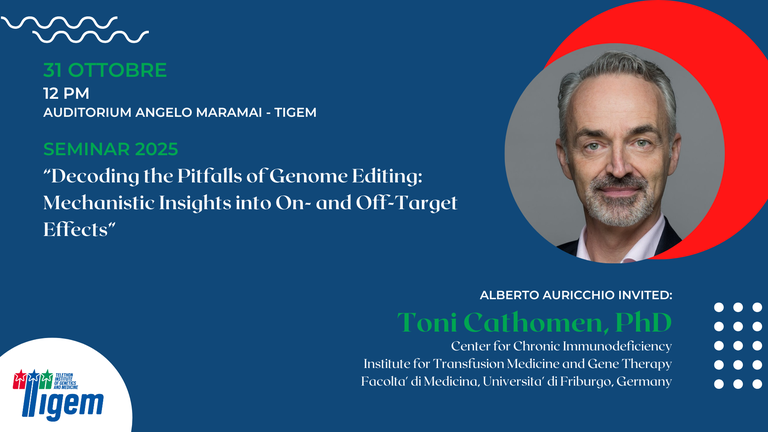
Toni Cathomen, PhD - "Decoding the Pitfalls of Genome Editing: Mechanistic Insights into On- and Off-Target Effects"
- When Oct 31, 2025 from 12:00 PM to 01:15 PM (Europe/Berlin / UTC100)
- Where Tigem Auditorium Angelo Maramai
- Contact Name Alberto Auricchio
- Contact Phone 08119230659
-
Add event to calendar
 iCal
iCal
- https://www.tigem.it/newsroom/seminars/toni-cathomen-phd-decoding-the-pitfalls-of-genome-editing-mechanistic-insights-into-on-and-off-target-effects
- Toni Cathomen, PhD - "Decoding the Pitfalls of Genome Editing: Mechanistic Insights into On- and Off-Target Effects"
- 2025-10-31T12:00:00+01:00
- 2025-10-31T13:15:00+01:00
Toni Cathomen, PhD
Center for Chronic Immunodeficiency
Institute for Transfusion Medicine and Gene Therapy
Facolta' di Medicina
Universita' di Friburgo
Germany
Short CV
Abstract
The clinical approval of the first CRISPR-based therapy marks a pivotal milestone for genome editing and demonstrates the transformative potential of this technology in treating genetic diseases. Positive clinical outcomes from genome- and base-editing trials in hemoglobinopathies, amyloidosis, and engineered immune cells highlight the breadth of therapeutic opportunities now within reach. At the same time, systematic analyses of “suboptimal” editing strategies reveal critical insights into unintended genomic alterations. Beyond classical off-target mutations, on-target aberrations such as large deletions, insertions, and chromosomal rearrangements remain significant safety concerns. This presentation will outline milestones in clinical application of genome editing alongside current strategies to evaluate the fidelity of genome editors. Comparative studies of nucleases, nickases, and base editors uncover mechanistic links between editing modalities, DNA repair pathways, and genotoxic outcomes. By learning from imperfect setups, we gain a deeper understanding of the limitations of current platforms and inform the design of next-generation editors with improved precision and safety, ultimately advancing their therapeutic potential.
Center for Chronic Immunodeficiency
Institute for Transfusion Medicine and Gene Therapy
Facolta' di Medicina
Universita' di Friburgo
Germany
Short CV
Abstract
The clinical approval of the first CRISPR-based therapy marks a pivotal milestone for genome editing and demonstrates the transformative potential of this technology in treating genetic diseases. Positive clinical outcomes from genome- and base-editing trials in hemoglobinopathies, amyloidosis, and engineered immune cells highlight the breadth of therapeutic opportunities now within reach. At the same time, systematic analyses of “suboptimal” editing strategies reveal critical insights into unintended genomic alterations. Beyond classical off-target mutations, on-target aberrations such as large deletions, insertions, and chromosomal rearrangements remain significant safety concerns. This presentation will outline milestones in clinical application of genome editing alongside current strategies to evaluate the fidelity of genome editors. Comparative studies of nucleases, nickases, and base editors uncover mechanistic links between editing modalities, DNA repair pathways, and genotoxic outcomes. By learning from imperfect setups, we gain a deeper understanding of the limitations of current platforms and inform the design of next-generation editors with improved precision and safety, ultimately advancing their therapeutic potential.