
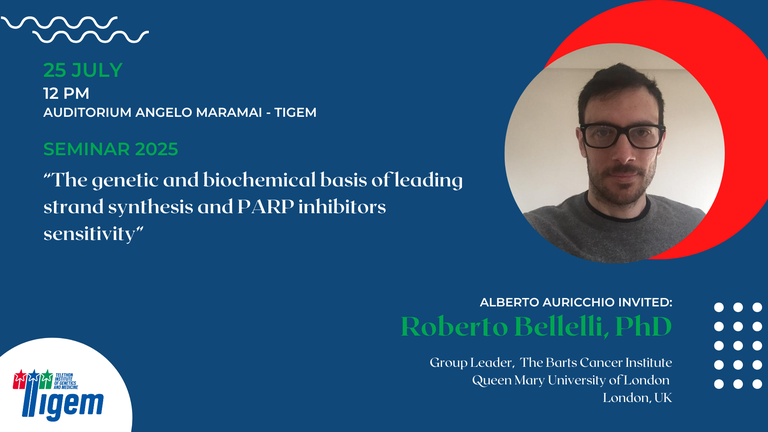
Roberto Bellelli, PhD - "The genetic and biochemical basis of leading strand synthesis and PARP inhibitors sensitivity"
- When Jul 25, 2025 from 12:00 PM to 01:00 PM (Europe/Berlin / UTC200)
- Where Auditorium Angelo Maramai
- Contact Name Alberto Auricchio
- Contact Phone 08119230659
-
Add event to calendar
 iCal
iCal
- https://www.tigem.it/newsroom/seminars/roberto-bellelli-phd-the-genetic-and-biochemical-basis-of-leading-strand-synthesis-and-parp-inhibitors-sensitivity
- Roberto Bellelli, PhD - "The genetic and biochemical basis of leading strand synthesis and PARP inhibitors sensitivity"
- 2025-07-25T12:00:00+02:00
- 2025-07-25T13:00:00+02:00
Roberto Bellelli, PhD
Group Leader, The Barts Cancer Institute
Queen Mary University of London
London, UK
Short CV
Abstract
Genomic instability is a hallmark of cancer and understanding its nature has provided avenues for cancer therapy. The most prominent example has been the successful use of PARP inhibitors (PARPi) in BRCA1/BRCA2-mutated cancers. We have recently discovered that loss of the POLE3-POLE4 subunits of DNA Polymerase Epsilon (Pole) sensitizes cancer cells to PARPi by unleashing replicative gap accumulation (Hill, Ozgencil et al., Cell Reports 2024). By performing a genome-wide CRISPR screening in POLE4 KO cells, we now show that loss of POLE3-POLE4 is synthetic lethal with deletion of a series of iron metabolism genes and components of the CHTF18-RFC2/5 complex. By combining cell biology, structural modelling and biochemistry, we define the existence of two tiers of regulation of Pole processivity: leading strand-specific loading of PCNA by CHTF18-RFC2/5 and binding of newly synthesised dsDNA by POLE3-POLE4. Consistently with loss of Pole processivity being crucial for sensitization to PARPi, we further show that deletion of CHTF18 sensitizes cancer cells to PARPi by promoting replicative gap accumulation. Thus, POLE3-POLE4 and CHTF18-RFC2/5 represent two essential “tiers” required to maintain Pole processivity and prevent replicative gap accumulation.
Group Leader, The Barts Cancer Institute
Queen Mary University of London
London, UK
Short CV
Abstract
Genomic instability is a hallmark of cancer and understanding its nature has provided avenues for cancer therapy. The most prominent example has been the successful use of PARP inhibitors (PARPi) in BRCA1/BRCA2-mutated cancers. We have recently discovered that loss of the POLE3-POLE4 subunits of DNA Polymerase Epsilon (Pole) sensitizes cancer cells to PARPi by unleashing replicative gap accumulation (Hill, Ozgencil et al., Cell Reports 2024). By performing a genome-wide CRISPR screening in POLE4 KO cells, we now show that loss of POLE3-POLE4 is synthetic lethal with deletion of a series of iron metabolism genes and components of the CHTF18-RFC2/5 complex. By combining cell biology, structural modelling and biochemistry, we define the existence of two tiers of regulation of Pole processivity: leading strand-specific loading of PCNA by CHTF18-RFC2/5 and binding of newly synthesised dsDNA by POLE3-POLE4. Consistently with loss of Pole processivity being crucial for sensitization to PARPi, we further show that deletion of CHTF18 sensitizes cancer cells to PARPi by promoting replicative gap accumulation. Thus, POLE3-POLE4 and CHTF18-RFC2/5 represent two essential “tiers” required to maintain Pole processivity and prevent replicative gap accumulation.