
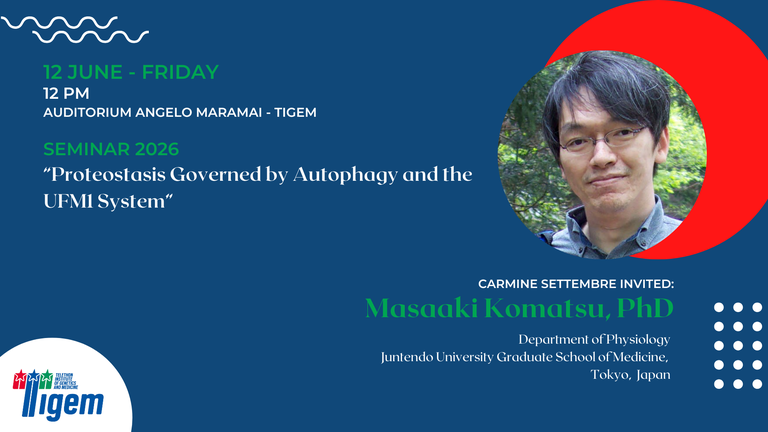
PLEASE NOTE THE UNUSUAL DAY. Masaaki Komatsu, PhD - "Proteostasis Governed by Autophagy and the UFM1 System"
- When Jun 12, 2026 from 12:00 PM to 01:15 PM (Europe/Berlin / UTC200)
- Where Tigem Auditorium Angelo Maramai
- Contact Name Carmine Settembre
- Contact Phone 3392055239
-
Add event to calendar
 iCal
iCal
- https://www.tigem.it/newsroom/seminars/masaaki-komatsu-phd-proteostasis-governed-by-autophagy-and-the-ufm1-system
- PLEASE NOTE THE UNUSUAL DAY. Masaaki Komatsu, PhD - "Proteostasis Governed by Autophagy and the UFM1 System"
- 2026-06-12T12:00:00+02:00
- 2026-06-12T13:15:00+02:00
Masaaki Komatsu, PhD
Department of Physiology
Juntendo University Graduate School of Medicine
Tokyo, Japan
Short CV
Abstract
Proteostasis is safeguarded by multiple quality-control pathways, among which selective autophagy and the UFM1 system provide distinct yet complementary modes of regulation. In the first part of this talk, I will discuss how p62/SQSTM1-mediated selective autophagy is controlled through phosphorylation-dependent remodeling of p62 condensates. TBK1-mediated phosphorylation at Ser403 acts as a molecular rheostat that miniaturizes and gels p62 bodies, thereby enhancing their capacity to capture LC3-positive membranes and accelerate autophagic clearance of ubiquitinated proteins. This modification is counteracted by PP2A holoenzymes recruited via KEAP1. Phosphorylation-mimetic knock-in cells and mice accumulate compact, gel-like p62 condensates, demonstrating that this material-state switch operates across cellular and organismal levels to maintain proteostasis.
In the second part, I will present our findings on how proteostasis is further secured by a finely tuned cycle of UFM1 conjugation and deconjugation within the endoplasmic reticulum–associated ribosome quality-control (ER-RQC) pathway. The ER-anchored UFSP2–ODR4 complex functions as a spatially restricted deUFMylation module for RPL26. Disruption of this module—or excessive UFM1 conjugation caused by biallelic UFC1 mutations—results in hyper-UFMylation, impaired ER-RQC, and neurodevelopmental defects. Together, these studies highlight how autophagy and the UFM1 system jointly govern neuronal proteostasis.