
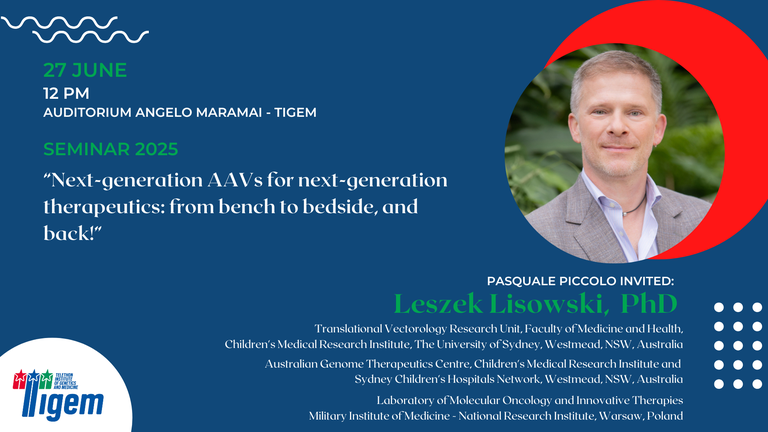
Leszek Lisowski, PhD - "Next-generation AAVs for next-generation therapeutics: from bench to bedside, and back!”
- When Jun 27, 2025 from 12:00 PM to 01:00 PM (Europe/Berlin / UTC200)
- Where Auditorium Angelo Maramai
- Contact Name Pasquale Piccolo
- Contact Phone 08119230659
-
Add event to calendar
 iCal
iCal
- https://www.tigem.it/newsroom/seminars/leszek-lisowski-phd-next-generation-aavs-for-next-generation-therapeutics-from-bench-to-bedside-and-back-201d
- Leszek Lisowski, PhD - "Next-generation AAVs for next-generation therapeutics: from bench to bedside, and back!”
- 2025-06-27T12:00:00+02:00
- 2025-06-27T13:00:00+02:00
Translational Vectorology Research Unit, Faculty of Medicine and Health,
Children's Medical Research Institute, The University of Sydney, Westmead, NSW, Australia
Australian Genome Therapeutics Centre, Children's Medical Research Institute and
Sydney Children's Hospitals Network, Westmead, NSW, Australia
Laboratory of Molecular Oncology and Innovative Therapies
Military Institute of Medicine - National Research Institute, Warsaw, Poland
Short CV
Abstract
Adeno-associated virus (AAV) vectors are currently the most widely used platform for in vivo gene therapy. To date, eight AAV-based gene augmentation therapies have received market authorization in the US and Europe, with additional approvals expected in the near future. However, most clinically used AAV variants are derived from naturally occurring viruses that evolved to infect human or non-human primate cells—not to function as optimized delivery vehicles for therapeutic applications. As a result, several challenges remain, including: (i) low transduction efficiency in primary human cells, necessitating high vector doses to achieve therapeutic effect; (ii) high prevalence of pre-existing neutralizing antibodies; and (iii) poor tissue specificity, leading to off-target vector distribution. These limitations collectively reduce safety and increase the cost of AAV-based treatments.
AAV bioengineering offers a promising path forward by enabling the creation of custom-designed vectors tailored for specific clinical needs. Engineered AAVs can be optimized not only for efficiency and specificity but also for reduced immunogenicity and improved manufacturability.
In his presentation, Prof. Lisowski will discuss successful AAV capsid engineering strategies, including rational design, high-throughput library screening, and emerging in silico approaches. He will also highlight the application of AAV vectors in gene editing, as well as innovative combinatorial strategies that integrate AAV with non-viral delivery systems to advance safer and more effective therapies. The talk will conclude with an overview of Prof. Lisowski’s ongoing translational projects aimed at developing AAV-based gene therapies for rare and ultra-rare paediatric disorders.