
Julia Obergasteiger, PhD - ""Modulating lysosomal dysfunction in proteinopathy-linked neurodegeneration: Insights from novel targets RIT2 and FLCN in Parkinson's Disease"
- When Sep 02, 2025 from 12:00 PM to 01:00 PM (Europe/Berlin / UTC200)
- Where Tigem Auditorium Angelo Maramai
- Contact Name Gennaro Napolitano
- Contact Phone 08119230659
-
Add event to calendar
 iCal
iCal
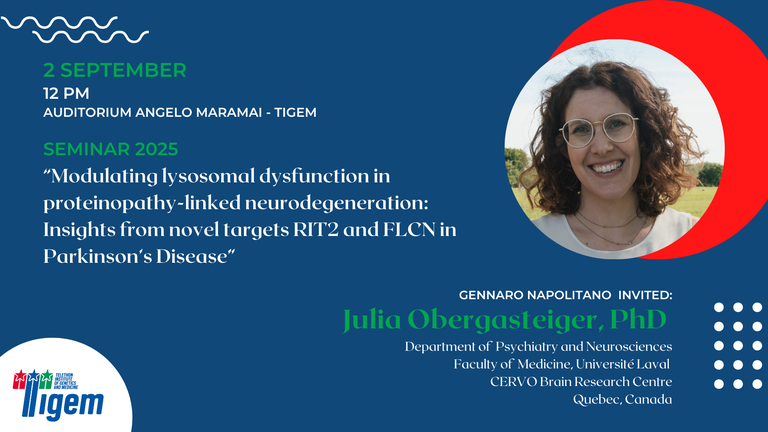
- https://www.tigem.it/newsroom/seminars/julia-obergasteiger-phd-modulating-lysosomal-dysfunction-in-proteinopathy-linked-neurodegeneration-insights-from-novel-targets-rit2-and-flcn-in-parkinsons-disease
- Julia Obergasteiger, PhD - ""Modulating lysosomal dysfunction in proteinopathy-linked neurodegeneration: Insights from novel targets RIT2 and FLCN in Parkinson's Disease"
- 2025-09-02T12:00:00+02:00
- 2025-09-02T13:00:00+02:00
Julia Obergasteiger, PhD
Department of Psychiatry and Neurosciences
Faculty of Medicine, Université Laval
CERVO Brain Research Centre
Quebec, Canada
Short CV
Abstract
Neurodegenerative disorders characterized by protein aggregation, such as Parkinson’s disease (PD), are strongly linked to impairments in the autophagy–lysosome pathway (ALP). Genome-wide association studies have identified over 100 PD risk loci, many containing genes involved in ALP regulation. One hallmark of PD is the accumulation of misfolded, phosphorylated alpha-synuclein (aSyn), and enhancing ALP function has shown promise in reducing such aggregates.
We identified the small GTPase RIT2 as a novel modulator of lysosomal activity and aSyn pathology. Mechanistically, RIT2 interacts with LRRK2 kinase, a key contributor to ALP dysfunction in PD.In another project, we performed a CRISPR-based, genome-wide screen and identified Flcn as a candidate gene for protecting dopaminergic neurons from degeneration. In vitro, Flcn knockout (KO) increased dopaminergic neuron viability under oxidative stress. In vivo, Flcn KO in substantia nigra pars compacta (SNc) dopamine neurons protected against AAV-mediated aSyn overexpression, ameliorating motor deficits, preserving dopaminergic neurons and striatal terminals, and reducing phosphorylated aSyn levels.Human iPSC-derived dopaminergic neurons from PD patients carrying either the triplication of the SNCA gene or the A53T-aSyn mutation, and the respective isogenic controls display lysosomal and mitochondrial defects. FLCN KO decreases aSyn aggregation and increases the expression of lysosomal genes.
Our findings highlight RIT2 and the FLCN as interesting targets for restoring lysosomal activity in PD. Modulation of the associated pathways might enhance proteostasis, reduce pathological protein accumulation, and protect dopaminergic neurons, offering a promising therapeutic strategy for proteinopathy-linked neurodegeneration.