
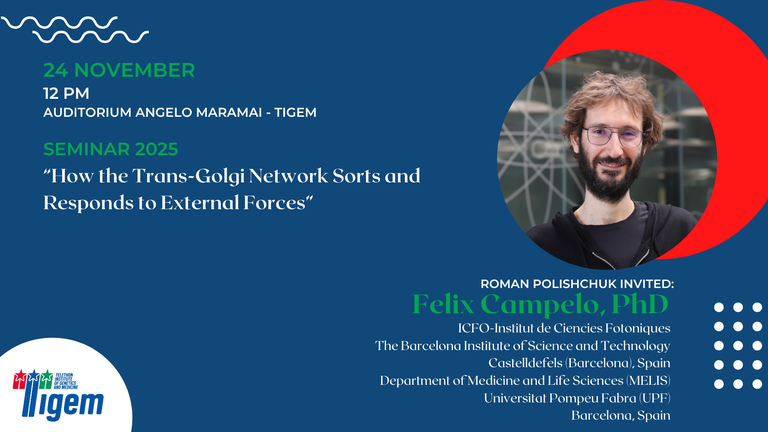
Felix Campelo, PhD - "How the Trans-Golgi Network Sorts and Responds to External Forces"
- When Nov 24, 2025 from 12:00 PM to 01:15 PM (Europe/Berlin / UTC100)
- Where Tigem Auditorium Angelo Maramai
- Contact Name Roman Polishchuk
- Contact Phone 08119230659
-
Add event to calendar
 iCal
iCal
- https://www.tigem.it/newsroom/seminars/felix-campelo-phd-how-the-trans-golgi-network-sorts-and-responds-to-external-forces
- Felix Campelo, PhD - "How the Trans-Golgi Network Sorts and Responds to External Forces"
- 2025-11-24T12:00:00+01:00
- 2025-11-24T13:15:00+01:00
Felix Campelo, PhD
ICFO-Institut de Ciencies Fotoniques
The Barcelona Institute of Science and Technology
Castelldefels (Barcelona), Spain
Department of Medicine and Life Sciences (MELIS)
Universitat Pompeu Fabra (UPF)
Barcelona, Spain
Short CV
Abstract
The trans-Golgi network (TGN) is a central hub in the secretory pathway, orchestrating the sorting and export of newly synthesized proteins to their final destinations. Yet, both the molecular mechanisms of cargo sorting and the regulation of TGN function by external cues remain incompletely understood. In this talk, I will present two interconnected stories that shed light on these processes.
First, I will describe our recent work uncovering a key role for the transmembrane protein TGN46 in the sorting of secretory glycoproteins into a specific class of TGN-to-plasma membrane transport carriers known as CARTS (carriers of the trans-Golgi network to the cell surface). We showed that the lumenal domain of TGN46 is both necessary and sufficient for cargo sorting into CARTS, and that it can undergo phase separation in vitro, suggesting a biophysical mechanism for selective cargo packaging at the TGN.
Second, I will discuss our unpublished findings revealing that the secretory activity of the Golgi is mechanoresponsive. Using substrates of defined stiffness, mechanical stretching, and ligand-specific spreading assays, we showed that external mechanical cues can modulate the rate of Golgi export. This mechanotransduction involves a pathway that includes microtubule acetylation, diacylglycerol signaling, modulation of Golgi membrane tension, and protein kinase D activity.
Together, these findings highlight the TGN as both a biochemical sorter and a mechanoresponsive hub, integrating local molecular mechanisms with external mechanical inputs to adapt secretory output to the physical environment. This dual perspective opens new avenues for understanding how secretion is tuned in development, tissue remodeling, and disease.
ICFO-Institut de Ciencies Fotoniques
The Barcelona Institute of Science and Technology
Castelldefels (Barcelona), Spain
Department of Medicine and Life Sciences (MELIS)
Universitat Pompeu Fabra (UPF)
Barcelona, Spain
Short CV
Abstract
The trans-Golgi network (TGN) is a central hub in the secretory pathway, orchestrating the sorting and export of newly synthesized proteins to their final destinations. Yet, both the molecular mechanisms of cargo sorting and the regulation of TGN function by external cues remain incompletely understood. In this talk, I will present two interconnected stories that shed light on these processes.
First, I will describe our recent work uncovering a key role for the transmembrane protein TGN46 in the sorting of secretory glycoproteins into a specific class of TGN-to-plasma membrane transport carriers known as CARTS (carriers of the trans-Golgi network to the cell surface). We showed that the lumenal domain of TGN46 is both necessary and sufficient for cargo sorting into CARTS, and that it can undergo phase separation in vitro, suggesting a biophysical mechanism for selective cargo packaging at the TGN.
Second, I will discuss our unpublished findings revealing that the secretory activity of the Golgi is mechanoresponsive. Using substrates of defined stiffness, mechanical stretching, and ligand-specific spreading assays, we showed that external mechanical cues can modulate the rate of Golgi export. This mechanotransduction involves a pathway that includes microtubule acetylation, diacylglycerol signaling, modulation of Golgi membrane tension, and protein kinase D activity.
Together, these findings highlight the TGN as both a biochemical sorter and a mechanoresponsive hub, integrating local molecular mechanisms with external mechanical inputs to adapt secretory output to the physical environment. This dual perspective opens new avenues for understanding how secretion is tuned in development, tissue remodeling, and disease.