
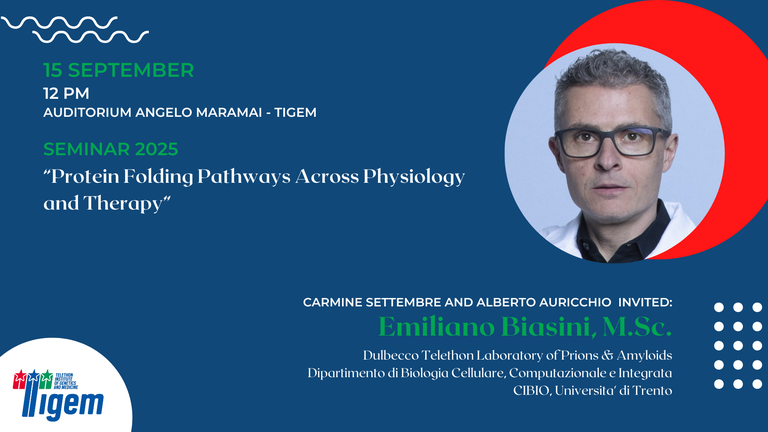
Emiliano Biasini, M.Sc. - "Protein Folding Pathways Across Physiology and Therapy"
- When Sep 15, 2025 from 12:00 PM to 01:00 PM (Europe/Berlin / UTC200)
- Where Tigem Auditorium Angelo Maramai
- Contact Name Carmine Settembre
- Contact Phone 08119230659
-
Add event to calendar
 iCal
iCal
- https://www.tigem.it/newsroom/seminars/emiliano-biasini-m-sc-protein-folding-pathways-across-physiology-and-therapy
- Emiliano Biasini, M.Sc. - "Protein Folding Pathways Across Physiology and Therapy"
- 2025-09-15T12:00:00+02:00
- 2025-09-15T13:00:00+02:00
Emiliano Biasini, M.Sc.
Dulbecco Telethon Laboratory of Prions & Amyloids
Dipartimento di Biologia Cellulare, Computazionale e Integrata
CIBIO, Universita' di Trento
Short CV
Abstract:
Advances in computational and experimental methods have revealed the existence of transient, non-native protein folding intermediates that could play roles in disparate biological processes, from regulation of protein expression to disease-relevant misfolding mechanisms. We recently described the Pharmacological Protein Inactivation by Folding Intermediate Targeting (PPI-FIT), a conceptual framework that leverages the transient exposure of non-native pockets during protein folding pathways to modulate protein expression pharmacologically. Inspired by this paradigm, we investigated whether specific post-translational modifications (PTMs) may target residues transiently accessible during folding pathways and influence proteostasis. By analyzing the solvent accessibility of 87,138 PTM sites in the human proteome, we found that approximately one-third of phosphorylated proteins harbor at least one phosphosite completely buried in the native structure. Computational modeling and experimental validation suggest that these cryptic phosphosites become exposed during the folding process, where their phosphorylation can destabilize the protein and trigger degradation. Notably, these sites are more evolutionarily conserved than surface-exposed phosphosites, suggesting functional relevance. Furthermore, integration with cancer mutation databases reveals that phosphomimetic substitutions at cryptic sites are associated with increased tumor fitness, likely through inactivation of tumor suppressors. Together, these findings uncover a previously unappreciated role for co-translational phosphorylation in regulating protein stability and expression, and provide a mechanistic foundation for developing PPI-FIT-inspired strategies to manipulate proteostasis in disease.
Dulbecco Telethon Laboratory of Prions & Amyloids
Dipartimento di Biologia Cellulare, Computazionale e Integrata
CIBIO, Universita' di Trento
Short CV
Abstract:
Advances in computational and experimental methods have revealed the existence of transient, non-native protein folding intermediates that could play roles in disparate biological processes, from regulation of protein expression to disease-relevant misfolding mechanisms. We recently described the Pharmacological Protein Inactivation by Folding Intermediate Targeting (PPI-FIT), a conceptual framework that leverages the transient exposure of non-native pockets during protein folding pathways to modulate protein expression pharmacologically. Inspired by this paradigm, we investigated whether specific post-translational modifications (PTMs) may target residues transiently accessible during folding pathways and influence proteostasis. By analyzing the solvent accessibility of 87,138 PTM sites in the human proteome, we found that approximately one-third of phosphorylated proteins harbor at least one phosphosite completely buried in the native structure. Computational modeling and experimental validation suggest that these cryptic phosphosites become exposed during the folding process, where their phosphorylation can destabilize the protein and trigger degradation. Notably, these sites are more evolutionarily conserved than surface-exposed phosphosites, suggesting functional relevance. Furthermore, integration with cancer mutation databases reveals that phosphomimetic substitutions at cryptic sites are associated with increased tumor fitness, likely through inactivation of tumor suppressors. Together, these findings uncover a previously unappreciated role for co-translational phosphorylation in regulating protein stability and expression, and provide a mechanistic foundation for developing PPI-FIT-inspired strategies to manipulate proteostasis in disease.