
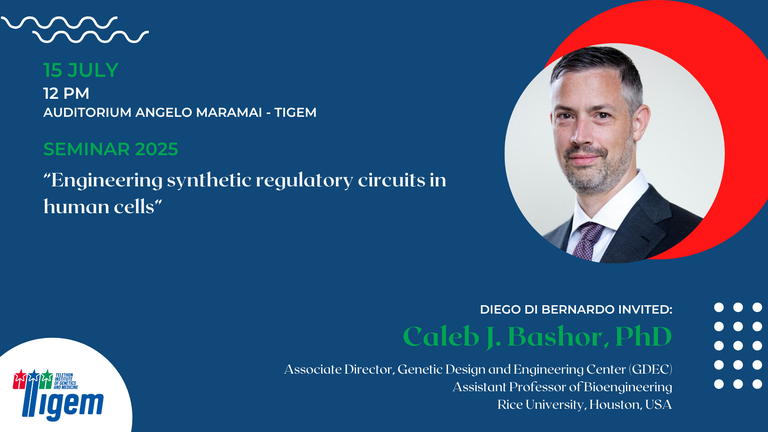
Caleb J. Bashor, PhD - "Engineering synthetic regulatory circuits in human cells"
- When Jul 15, 2025 from 12:00 PM to 01:00 PM (Europe/Berlin / UTC200)
- Where Auditorium Angelo Maramai
- Contact Name Diego di Bernardo
- Contact Phone 08119230659
-
Add event to calendar
 iCal
iCal
- https://www.tigem.it/newsroom/seminars/caleb-j-bashor-phd-engineering-synthetic-regulatory-circuits-in-human-cells
- Caleb J. Bashor, PhD - "Engineering synthetic regulatory circuits in human cells"
- 2025-07-15T12:00:00+02:00
- 2025-07-15T13:00:00+02:00
Caleb J. Bashor, PhD
Associate Director
Genetic Design and Engineering Center (GDEC)
Assistant Professor of Bioengineering
Rice University, Houston, USA
Short CV
Abstract
Recent advances in synthetic biology in mammalian cells have opened the door to precisely programming human cell-based therapeutics for specific indications. However, challenges remain—particularly in developing flexible, cell-specific circuit design frameworks and efficient workflows to navigate iterative engineering cycles. Here, I will present two projects from my research group that seek to overcome these barriers. The first project focuses on engineering cells to rapidly sense and respond to external changes through artificial phosphorylation-based signaling networks. Our design strategy involves building reversible enzymatic cycles from protein domain building blocks that, when integrated with synthetic receptors, allow cells to rapidly respond to extracellular ligands. This design further enables downstream regulation of gene expression, rapid secretion, molecular condensate formation, and reconstitution of reporter proteins, paving the way for cell-based theranostic devices capable of sensing disease markers and delivering therapeutic outputs. The second project introduces CLASSIC, an experimental pipeline for mapping genotype-to-phenotype relationships across expansive (10^5–10^6) gene circuit libraries. By leveraging pooled DNA assembly combined with long- and short-read next-generation sequencing, CLASSIC can be used to generate highly accurate design-to-function mappings across large circuit design spaces. The datasets generated by CLASSIC not only facilitate the rapid identification of optimized circuit variants but also serve as training data for machine learning models that can predict the performance of untested variants. Together, these approaches significantly expand the scale and scope of synthetic biology and lay the foundation for data-driven genetic circuit design.