
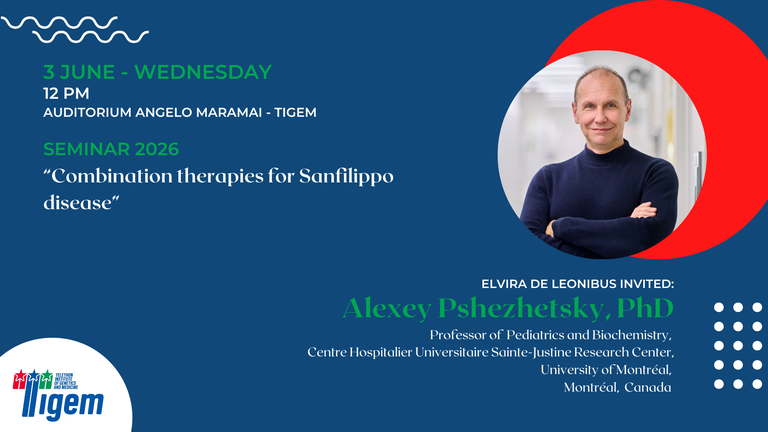
Alexey Pshezhetsky, PhD - "Combination therapies for Sanfilippo disease"
- When Jun 03, 2026 from 12:00 PM to 01:15 PM (Europe/Berlin / UTC200)
- Where Tigem, Auditorium Angelo Maramai
- Contact Name Elvira De Leonibus
- Contact Phone 0811923659
-
Add event to calendar
 iCal
iCal
- https://www.tigem.it/newsroom/seminars/alexey-pshezhetsky-phd-combination-therapies-for-sanfilippo-disease
- Alexey Pshezhetsky, PhD - "Combination therapies for Sanfilippo disease"
- 2026-06-03T12:00:00+02:00
- 2026-06-03T13:15:00+02:00
Alexey Pshezhetsky, PhD
Professor of Pediatrics and Biochemistry,
Centre Hospitalier Universitaire Sainte-Justine Research Center,
University of Montréal,
Montréal, Canada
Short CV
Abstract
Mucopolysaccharidosis (MPS) III, or Sanfilippo disease, is a spectrum of 4 rare neurologic lysosomal storage diseases caused by a genetic deficiencies of the enzymes participating in degradation of heparan sulphate (HS). This leads to HS storage in the cells of the central nervous system causing neuroinflammation and neurodegeneration. Patients present a progressive loss of cognitive functions and childhood dementia from an early age, eventually leading to a premature death. No treatments are clinically approved and previous and ongoing clinical trials demonstrate that gene therapy alone can’t reverse clinical symptoms. In addition, MPS IIIC is caused by defects in a transmembrane enzyme, incapable of free diffusion between cells and crossing the blood-brain barrier (BBB), rendering therapies based on enzyme replacement.
I will summarize the recent work from our lab aimed on development of therapies for MPS III based on a combination of a stem cell/gene therapy with small molecule drugs that block or reverse secondary pathological changes in the CNS. In particular, we used irreversible brain-permeable inhibitor, E64 (Aloxistatin) to block lysosomal cysteine endopeptidase, cathepsin B (CTSB), involved in pathogenic accumulation of amyloid deposits in the cortical neurons. MPS IIIC mice transplanted with wild-type HSPC and chronically treated with E64, show a complete rescue of behavioural and memory deficits and a long-term survival. In contrast, the untreated transplanted MPS IIIC mice show only a partial recovery. We also developed a synthetic peptide AVP6, an analog of adrenocorticotropic hormone fragment, to rescue deficient synaptic transmission and neuroinflammatory response. We show that intranasal administration of AVP6 to MPS IIIA,B and C mice reduces hyperactivity and rescues defects in working and spatial memory, delays progression of CNS pathology and increases the lifespan. Together with the absence of any adverse reactions to E64 or AVP6 in the MPS III and WT mice, our results justify testing the drug’s efficacy in clinical settings.
Professor of Pediatrics and Biochemistry,
Centre Hospitalier Universitaire Sainte-Justine Research Center,
University of Montréal,
Montréal, Canada
Short CV
Abstract
Mucopolysaccharidosis (MPS) III, or Sanfilippo disease, is a spectrum of 4 rare neurologic lysosomal storage diseases caused by a genetic deficiencies of the enzymes participating in degradation of heparan sulphate (HS). This leads to HS storage in the cells of the central nervous system causing neuroinflammation and neurodegeneration. Patients present a progressive loss of cognitive functions and childhood dementia from an early age, eventually leading to a premature death. No treatments are clinically approved and previous and ongoing clinical trials demonstrate that gene therapy alone can’t reverse clinical symptoms. In addition, MPS IIIC is caused by defects in a transmembrane enzyme, incapable of free diffusion between cells and crossing the blood-brain barrier (BBB), rendering therapies based on enzyme replacement.
I will summarize the recent work from our lab aimed on development of therapies for MPS III based on a combination of a stem cell/gene therapy with small molecule drugs that block or reverse secondary pathological changes in the CNS. In particular, we used irreversible brain-permeable inhibitor, E64 (Aloxistatin) to block lysosomal cysteine endopeptidase, cathepsin B (CTSB), involved in pathogenic accumulation of amyloid deposits in the cortical neurons. MPS IIIC mice transplanted with wild-type HSPC and chronically treated with E64, show a complete rescue of behavioural and memory deficits and a long-term survival. In contrast, the untreated transplanted MPS IIIC mice show only a partial recovery. We also developed a synthetic peptide AVP6, an analog of adrenocorticotropic hormone fragment, to rescue deficient synaptic transmission and neuroinflammatory response. We show that intranasal administration of AVP6 to MPS IIIA,B and C mice reduces hyperactivity and rescues defects in working and spatial memory, delays progression of CNS pathology and increases the lifespan. Together with the absence of any adverse reactions to E64 or AVP6 in the MPS III and WT mice, our results justify testing the drug’s efficacy in clinical settings.