One Year of the TIGEM Post-Doc Association: Building Community and New Opportunities for Researchers
Mar 18, 2026
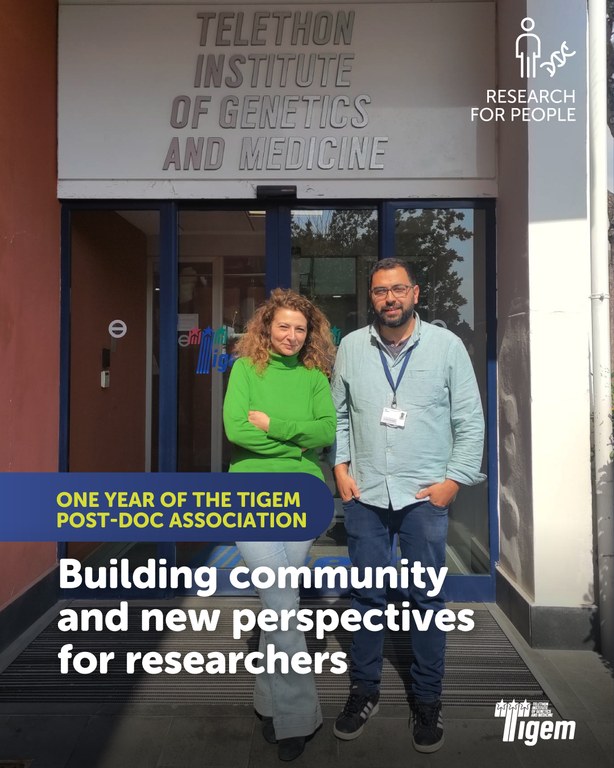
One year after its founding, the TIGEM Post-Doc Association has established itself as a key reference point for the institute’s postdocs. Born from a spontaneous initiative by the researchers themselves, the association now brings together all 86 postdocs, with an average age of 35.5 years, an average seniority of 3 years, and a composition of 64 women and 22 men, of whom 76 are Italian and 10 international.
With the aim of giving voice to an essential component of scientific research, the association has embarked on a path to create a structured space for discussion, training, and support, during a stage of the career often characterized by high competitiveness and uncertainty.
The association is led by Leandro R. Soria and Laura Giaquinto, senior postdocs elected as presidents. Both bring an international profile and solid scientific experience gained within TIGEM.
Laura, originally from Naples, earned a degree in Chemistry from the University of Naples Federico II and a PhD in Microbiology and Immunology from the University of New South Wales, Australia. Since 2007, she has been a Postdoctoral Fellow at TIGEM, contributing to numerous projects on genetic diseases and COVID-19. She has recently become a researcher at the University of Naples Federico II, in the Department of Molecular Medicine and Medical Biotechnology.
Leandro, born in Argentina, earned a degree in Biotechnology and a PhD in Biological Sciences from the National University of Rosario. Since 2014, he has been a Postdoctoral Fellow at TIGEM, focusing on translational medicine and new therapies for hyperammonemia and urea cycle disorders. His current research explores regulatory post-translational modifications and new experimental models for these conditions.
With the experience and vision of Laura and Leandro, the TIGEM Post-Doc Association addresses a concrete need for representation. “Postdocs represent more than one-third of TIGEM’s scientific community” says Leandro. “It was important to give voice to this group and build a shared identity” adds Laura. The two presidents explain that taking on this role was first and foremost a gesture of responsibility toward the community:
“As some of the most senior postdocs, we decided to step up. It’s an important responsibility, but also an opportunity to contribute to the growth of the community by organizing workshops, training courses, and initiatives that support the scientific and professional development of younger colleagues.”
For Laura Giaquinto, the first year of the association was primarily a period of building: “Starting something new is always a challenge, but I wanted to help create an active and engaged postdoc community at TIGEM.” “We started from scratch, and the first thing was to listen to our colleagues, understand their needs, and build the association’s activities together” explains Leandro.
Among the most significant outcomes of this first year, one priority stands out clearly: addressing the challenges postdocs face in their professional paths. In particular, the risk of prolonged postdoc positions without progressing to the next career stage has emerged strongly—a situation widely shared in the national and international research landscape. “Many researchers associate success solely with the traditional academic path and the role of principal investigator, but that is not necessarily the only possible direction” emphasizes Laura.
Starting from this awareness, the TIGEM Post-Doc Association has made one of its strategic goals the expansion of postdocs’ career perspectives, providing concrete tools to explore diversified professional opportunities, both inside and outside academia. In this context, the career development group, coordinated by TIGEM postdoc Lorenzo Vaccaro and supported by Scientific Officer Valentina Bouchè, has been instrumental. Over the course of the year, numerous meetings and training days have been organized, involving national and international speakers, as well as participation from the SR-Tiget community. The various workshops have addressed key topics for researchers’ professional development: from grant writing and scouting, to intellectual property and patents, scientific communication, R&D in industry, and translational clinical research.
These initiatives have been fundamental in supporting postdocs to gain greater awareness of available opportunities and to make career choices that are better informed and aligned with their skills and aspirations.
“Our goal was to demonstrate concretely that there are multiple professional opportunities after the postdoc stage” notes Leandro R. Soria. “Engaging with professionals who have pursued diverse career paths is an invaluable support for those trying to navigate their own choices and define their trajectory.”
Looking ahead, the TIGEM Post-Doc Association aims to further strengthen initiatives dedicated to well-being and community life. From developing well-being activities to sharing laboratory resources and protocols, and improving the organization of workspaces, the community plans to intervene in several areas in the coming months.
Beyond individual initiatives, the association’s most significant value lies in creating a peer-based space for discussion and support, where members can share not only professional challenges but also personal experiences. “The postdoc community is an important resource both scientifically and personally” highlights Laura Giaquinto. “Younger researchers can benefit from managing the opportunities of this career stage, while senior colleagues face different responsibilities and pressures. Dialogue and exchange of experiences can make a real difference” adds Leandro R. Soria.
One year after its inception, the Post-Doc Association looks to the future with the goal of consolidating and expanding its role within TIGEM, valuing each member’s contribution and strengthening the sense of community.
The presidents’ final message to all colleagues:
“We thank all postdocs for participating in activities and for choosing us as presidents. The success of the association depends on everyone’s contribution: the enthusiasm shown during this first year provides a solid starting point on which to continue building an increasingly cohesive and representative community.”
With the aim of giving voice to an essential component of scientific research, the association has embarked on a path to create a structured space for discussion, training, and support, during a stage of the career often characterized by high competitiveness and uncertainty.
The association is led by Leandro R. Soria and Laura Giaquinto, senior postdocs elected as presidents. Both bring an international profile and solid scientific experience gained within TIGEM.
Laura, originally from Naples, earned a degree in Chemistry from the University of Naples Federico II and a PhD in Microbiology and Immunology from the University of New South Wales, Australia. Since 2007, she has been a Postdoctoral Fellow at TIGEM, contributing to numerous projects on genetic diseases and COVID-19. She has recently become a researcher at the University of Naples Federico II, in the Department of Molecular Medicine and Medical Biotechnology.
Leandro, born in Argentina, earned a degree in Biotechnology and a PhD in Biological Sciences from the National University of Rosario. Since 2014, he has been a Postdoctoral Fellow at TIGEM, focusing on translational medicine and new therapies for hyperammonemia and urea cycle disorders. His current research explores regulatory post-translational modifications and new experimental models for these conditions.
With the experience and vision of Laura and Leandro, the TIGEM Post-Doc Association addresses a concrete need for representation. “Postdocs represent more than one-third of TIGEM’s scientific community” says Leandro. “It was important to give voice to this group and build a shared identity” adds Laura. The two presidents explain that taking on this role was first and foremost a gesture of responsibility toward the community:
“As some of the most senior postdocs, we decided to step up. It’s an important responsibility, but also an opportunity to contribute to the growth of the community by organizing workshops, training courses, and initiatives that support the scientific and professional development of younger colleagues.”
For Laura Giaquinto, the first year of the association was primarily a period of building: “Starting something new is always a challenge, but I wanted to help create an active and engaged postdoc community at TIGEM.” “We started from scratch, and the first thing was to listen to our colleagues, understand their needs, and build the association’s activities together” explains Leandro.
Among the most significant outcomes of this first year, one priority stands out clearly: addressing the challenges postdocs face in their professional paths. In particular, the risk of prolonged postdoc positions without progressing to the next career stage has emerged strongly—a situation widely shared in the national and international research landscape. “Many researchers associate success solely with the traditional academic path and the role of principal investigator, but that is not necessarily the only possible direction” emphasizes Laura.
Starting from this awareness, the TIGEM Post-Doc Association has made one of its strategic goals the expansion of postdocs’ career perspectives, providing concrete tools to explore diversified professional opportunities, both inside and outside academia. In this context, the career development group, coordinated by TIGEM postdoc Lorenzo Vaccaro and supported by Scientific Officer Valentina Bouchè, has been instrumental. Over the course of the year, numerous meetings and training days have been organized, involving national and international speakers, as well as participation from the SR-Tiget community. The various workshops have addressed key topics for researchers’ professional development: from grant writing and scouting, to intellectual property and patents, scientific communication, R&D in industry, and translational clinical research.
These initiatives have been fundamental in supporting postdocs to gain greater awareness of available opportunities and to make career choices that are better informed and aligned with their skills and aspirations.
“Our goal was to demonstrate concretely that there are multiple professional opportunities after the postdoc stage” notes Leandro R. Soria. “Engaging with professionals who have pursued diverse career paths is an invaluable support for those trying to navigate their own choices and define their trajectory.”
Looking ahead, the TIGEM Post-Doc Association aims to further strengthen initiatives dedicated to well-being and community life. From developing well-being activities to sharing laboratory resources and protocols, and improving the organization of workspaces, the community plans to intervene in several areas in the coming months.
Beyond individual initiatives, the association’s most significant value lies in creating a peer-based space for discussion and support, where members can share not only professional challenges but also personal experiences. “The postdoc community is an important resource both scientifically and personally” highlights Laura Giaquinto. “Younger researchers can benefit from managing the opportunities of this career stage, while senior colleagues face different responsibilities and pressures. Dialogue and exchange of experiences can make a real difference” adds Leandro R. Soria.
One year after its inception, the Post-Doc Association looks to the future with the goal of consolidating and expanding its role within TIGEM, valuing each member’s contribution and strengthening the sense of community.
The presidents’ final message to all colleagues:
“We thank all postdocs for participating in activities and for choosing us as presidents. The success of the association depends on everyone’s contribution: the enthusiasm shown during this first year provides a solid starting point on which to continue building an increasingly cohesive and representative community.”