Return to build: the international journey of Pasqualina Colella and her return to TIGEM
After a research path spanning Italy, France, and the United States, Pasqualina Colella returns to TIGEM to launch a new project in the field of advanced therapies for rare genetic diseases. In this interview, she retraces the milestones of her scientific growth and shares the vision that now guides her work, spanning translational research, therapeutic innovation, and commitment to patients.
You carried out your training here at TIGEM from the very beginning. How did this experience shape your scientific identity?
“After earning my degree in Biology at the University of Naples Federico II, I began working in gene therapy in the group of Alberto Auricchio at TIGEM, where I completed my entire training path: from a post-graduate fellowship to a PhD with the Open University, and then a postdoc.
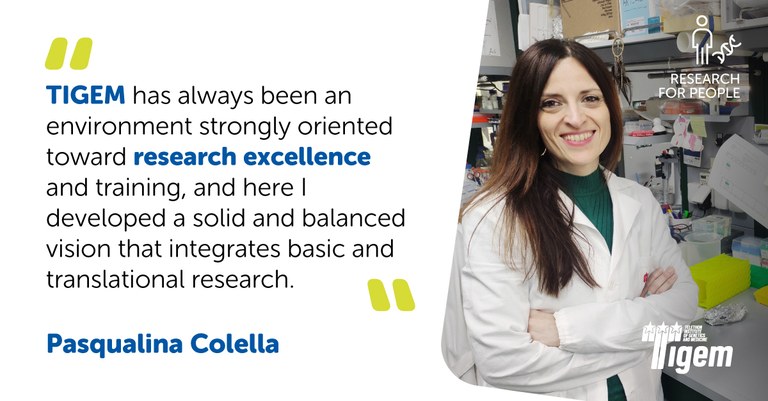
TIGEM has always been an environment strongly oriented toward research excellence and training, and here I developed a solid and balanced vision that integrates basic and translational research. During my eight years at TIGEM, I built strong expertise in the study of inherited retinal diseases, with a particular focus on large gene delivery—an emerging frontier in gene therapy that aims to overcome the cargo capacity limits of traditional AAV vectors and make previously untreatable genetic diseases addressable. This work led to important publications and results. In particular, my preclinical studies on dual AAV vectors in mouse models of Usher syndrome 1B laid the initial scientific groundwork for subsequent clinical developments in humans conducted at TIGEM. Having personally contributed to a concrete step forward from laboratory research toward therapeutic application represents one of the most meaningful aspects of my scientific journey.
TIGEM’s international outlook, together with participation in European consortia and international conferences—made possible also thanks to the guidance and support of Alberto Auricchio—played a decisive role in my growth, broadening my scientific perspective and significantly shaping my path.
My interest in studying rare diseases and my focus on the real-world impact of research also stem from my personal story: throughout my journey, I have learned a great deal from my sister, Rosa, affected by a rare neurodevelopmental and skeletal disorder. This dimension has made my scientific choices even more conscious and motivated, strengthening my desire to contribute to the development of advanced therapies that can have a real impact on the lives of patients and their families.”
After TIGEM you built extensive experience in other research settings. What were the most important steps along this path?
“In 2015, I found myself facing a decisive choice between two competitive postdoctoral fellowships: a Marie Curie fellowship on a basic biology project focused on lysosomal trafficking, or a fellowship at Généthon to continue my work in gene therapy. I chose the latter because it aligned with my interest in studying and developing therapeutic strategies for multi-organ diseases, which require the integration of biotechnology and control of immune responses for effective clinical application.
I remained at Généthon for four and a half years, a period during which I expanded my expertise and achieved results that contributed to the development of innovative experimental approaches for neuromuscular disorders, particularly Pompe disease, which were later translated into clinical studies. In parallel, I deepened my focus on immunity in gene therapy: understanding and modulating the immune response to therapeutic genes and viral vectors is crucial to making these approaches both effective and safe. This also led to my interest in complementary strategies that enable the replacement of microglia—the immune cells of the brain—with modified stem cells capable of producing therapeutic proteins and correcting neurological diseases.
This is the topic I worked on from 2020 at Stanford University as a Senior Scientist. There, I expanded my knowledge in the field of genome editing, focusing on ex vivo editing of hematopoietic stem cells and their transplantation for the treatment of diseases with neurological manifestations, including lysosomal storage disorders. My work led to the development of more efficient strategies for microglia replacement, with promising preclinical results in severe neurodegenerative diseases caused by progranulin and frataxin deficiency. This stage further enriched a multidisciplinary path integrating gene therapy, cell therapy, immunology, and editing platforms.
Developing diverse and complementary tools continues to guide my interests and my approach to research, enabling me to address complex problems and diseases with a prepared and integrated vision.”
Was there a specific motivation that led you to return to TIGEM, and from your perspective how has the institute changed since your training years?
“I always imagined that my international path was also preparation for a return. It was not a sudden decision, but the outcome of a consciously built journey: I wanted to broaden my expertise, develop a wider vision of research, and then bring this experience back to Italy to invest it in a long-term project. TIGEM represents one of the best contexts nationally to work with an international outlook and to develop innovative ideas with rigor and ambition.
Compared with the years of my training, the institute has grown profoundly—not only structurally and in size, but above all scientifically and technologically. Basic research and gene therapy programs have expanded, as have the infrastructures and synergies needed to support a full pathway from innovation to clinical translation. What was once predominantly preclinical has, in many cases, become clinical—such as in mucopolysaccharidosis type 6 (MPS6) and Usher syndrome 1B—demonstrating a vision that, over time, has translated into concrete results.”
What does it mean to you today to lead a research project at TIGEM, and what contribution would you like to make to the TIGEM scientific community?
“Leading a project today at the same institute where I trained is a source of great pride and responsibility for me: it means giving back what I learned here and elsewhere, contributing to the growth of a multidisciplinary, cutting-edge environment, and offering new generations a model of research that is open, rigorous, and interdisciplinary. At TIGEM, I would like to place my experience, preparation, and vision at the service of the institute by contributing with new scientific projects. I believe that integrating different approaches is essential to address complex biological problems and to advance research. I am a solution-oriented person: when a problem emerges, my instinct is to understand it and identify the next step.
Alongside this, I place great value on the human and educational dimension. My international experience in mentoring students and young researchers from diverse backgrounds has strengthened my commitment to valuing differences and fostering inclusion, creating an environment in which everyone can realize their potential. I would like to encourage the growth and scientific responsibility of the new generation of researchers, supporting a working context that is rigorous and grounded in critical thinking, yet at the same time stimulating, open, and positive.
I hope to bring this contribution, together with the desire to continue taking on new scientific challenges.”