From Basic Research to the Clinic: How TIGEM and Fondazione Telethon Are Revolutionizing Gene Therapy for Large Genes
Jul 15, 2025
A Major Step Forward for Rare Disease Treatment
AAVantgarde Bio, a clinical-stage biotechnology company and spin-off of the Telethon Institute of Genetics and Medicine (TIGEM), has received FDA clearance to launch a first-in-human clinical trial for Stargardt disease, a severe inherited retinal disorder. This achievement represents more than a regulatory milestone—it is the culmination of over a decade of pioneering research and technological innovation, made possible through the long-term support of Fondazione Telethon. It is also a powerful demonstration of how scientific ideas born in academic laboratories can lead to therapies that transform lives.
The Problem: Large Genes, Small Vectors
The Problem: Large Genes, Small Vectors
While gene therapy has already delivered hope to patients with several rare diseases, it has long faced a fundamental limitation: size. Most therapeutic approaches use adeno-associated viruses (AAVs) to deliver corrective genes, but AAVs can only carry about 4.7 kilobases of genetic material. This limitation becomes critical when dealing with many disease-causing genes, such as ABCA4, MYO7A, or OTOF, which are significantly larger. AAV vectors have become the gold standard for in vivo gene delivery because of their excellent safety profile, low immunogenicity, and long-term expression, as demonstrated by multiple approved gene therapies (such as Luxturna, Zolgensma, and Hemgenix) and dozens of ongoing clinical trials. However, their limited cargo capacity has meant that entire categories of inherited diseases—particularly those involving large genes—have remained out of reach for conventional AAV-based therapies, despite the progress in the field.
The Solution: Two Complementary Gene Delivery Technologies
At TIGEM, Professor Alberto Auricchio and his team set out to address this challenge by developing two innovative platforms that break the size barrier of AAV vectors without compromising their established advantages. Instead of replacing AAVs, they chose to enhance and adapt this clinically validated platform, precisely because of its track record of safety, scalability, and regulatory acceptance in both approved and investigational therapies worldwide.
Their first strategy, introduced in 2012, involved splitting the therapeutic gene into two overlapping fragments, each delivered by its own AAV vector. Once inside the cell, the fragments recombine to reconstruct the full-length gene, enabling expression of the therapeutic protein. This technique formed the foundation of TIGEM’s large-gene therapy efforts and has since been adopted globally.
To further improve precision and efficiency, the team developed a second approach based on engineered inteins—natural protein elements that splice two separate fragments of a protein back into one. In this system, the gene is split at the protein level, and the inteins reassemble the functional protein after translation. This intein-based dual vector strategy has shown impressive results in large animal models, with high levels of gene expression, strong therapeutic efficacy, and long-term safety. It is the core platform behind AAVantgarde Bio’s two lead clinical programs: one for Usher syndrome type 1B and the other for Stargardt disease.
The Financial Path: From Scientific Vision to Sustainable Development
The transformation of TIGEM’s large-gene delivery platform into clinical-stage programs was made possible thanks to a long-term, well-structured financial strategy that combined competitive public funding with targeted private investment in translational research and biotech growth.
A decisive boost came from the European Research Council (ERC), which awarded Professor Alberto Auricchio three prestigious grants over the span of a decade. The journey began in 2012 with an ERC Starting Grant (€1.5 million), which supported the initial development of the dual AAV vector platform. This was followed by an ERC Proof of Concept Grant (€150,000), specifically aimed at preparing the technology for clinical translation, particularly for inherited retinal disorders such as Usher syndrome type 1B. More recently, the program received further validation and support through an ERC Advanced Grant, recognizing the broader therapeutic potential of the platform and reinforcing its long-term sustainability.
In parallel, a major translational push was made possible thanks to the EU-funded project for Usher syndrome (UshTher) —a Horizon 2020 collaborative grant awarded in 2018, totaling €6 million. This funding enabled the creation of a strong network of academic, clinical, and industrial partners across Europe. The project specifically focused on bringing the Usher 1B therapy toward clinical application, supporting IND-enabling studies, manufacturing processes, and regulatory alignment. It was a critical step in building the infrastructure required for human testing, ultimately leading to the launch of the AAVB-081 program.

These public investments not only advanced the science but helped de-risk the technology and position it for private sector uptake. Building on this momentum, Fondazione Telethon—a longstanding supporter of Auricchio’s research—co-founded AAVantgarde Bio in 2021 through the Sofinnova-Telethon Fund, a specialized venture fund designed to translate Telethon-funded research into biotech innovation. The fund provided the initial seed capital, governance framework, and strategic guidance to ensure the company’s scientific credibility and clinical focus.
In 2023, AAVantgarde Bio secured a €61 million Series A round from global life science investors including Atlas Venture, Forbion, and Longwood Fund. This investment enabled the acceleration of two clinical-stage programs, supported industrial-scale AAV vector manufacturing, and backed regulatory submissions to both EMA and FDA. It also signaled strong investor confidence in the scientific platform developed at TIGEM and its potential to reshape the treatment landscape for large-gene disorders.
From TIGEM to the Clinic: The Birth of AAVantgarde Bio
These technologies, developed over years of basic research at TIGEM and matured through public and private investment, formed the scientific and strategic foundation of AAVantgarde Bio. Its mission: to bring gene therapy to diseases previously considered untreatable due to gene size.
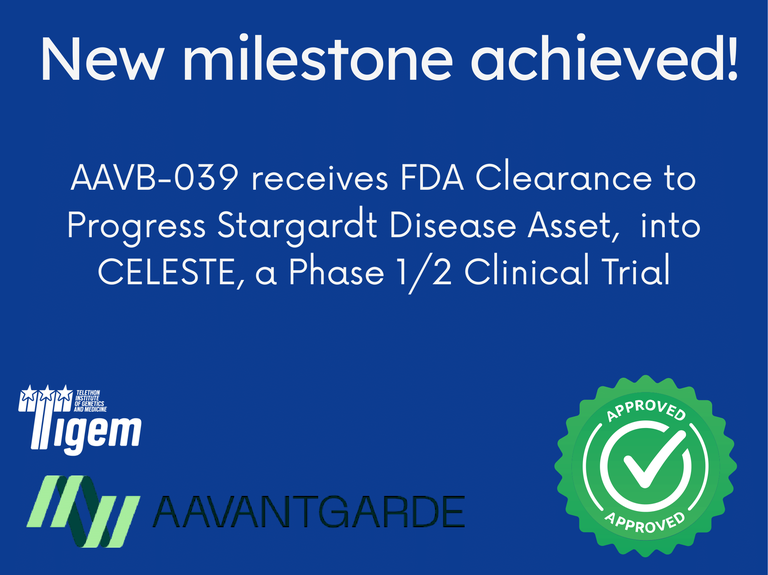
In 2024, AAVantgarde’s first candidate, AAVB-081, began clinical testing for Usher syndrome type 1B—the first time a dual AAV approach had ever been used in an ocular indication. In 2025, the FDA approved the start of clinical trials for a second program, AAVB-039, which targets Stargardt disease by delivering a full-length copy of the large ABCA4 gene. The trial, named CELESTE, builds upon data from STELLA, a prospective natural history study that continues to inform and refine the clinical development pathway.
A Platform with Global Impact: The OTOF Success Story
TIGEM’s dual AAV platform is not only advancing the company’s own pipeline—it is already transforming patient care globally. The same technology was licensed to Akouos, a U.S.-based biotech company acquired by Eli Lilly, to treat DFNB9, a severe form of congenital deafness caused by mutations in the OTOF gene.
In 2024, this technology enabled a world-first clinical success at the Children’s Hospital of Philadelphia, where an 11-year-old boy regained hearing after a single-patient trial using Auricchio’s dual AAV strategy. In 2025, a multicenter clinical study in China—now published in Nature Medicine—confirmed the safety and efficacy of the same approach in a broader group of patients, including toddlers, adolescents, and even the first adult ever treated for this condition.
These results highlight how innovative delivery technologies can unlock treatment options for diseases once considered untreatable. The dual AAV platform, born at TIGEM, is now proving its value globally—not only for deafness but potentially for any condition caused by large genes.
A Track Record of Translational Excellence
The success of AAVantgarde Bio—and the broader impact of TIGEM’s gene therapy technologies—would not have been possible without the strategic and long-term commitment of Fondazione Telethon. From the earliest stages of basic research to regulatory interactions and clinical development, Telethon played a pivotal role in identifying the scientific opportunity, de-risking the innovation, and securing the partnerships and investment needed to bring therapies to the clinic. This seamless progression from discovery to clinical impact is a testament to a coherent, patient-driven innovation model built to deliver cures.
Looking Ahead: Redefining the Reach of Gene Therapy
According to Auricchio, more than a thousand disease-causing genes are too large for standard AAV delivery. The platforms developed at TIGEM are now proving their utility not only in the retina or the inner ear but potentially across a wide range of tissues and conditions. With these tools, a new class of genetic diseases—once considered inaccessible to gene therapy—may now be treated.
This is not just a scientific achievement. It is a powerful case study in how institutional vision, scientific excellence, and strategic focus can deliver results that change the landscape of medicine and offer new hope to patients worldwide.