From Systems Biology to Smarter Gene Therapies: €2.5M ERC Grant Awarded to Diego Di Bernardo at TIGEM
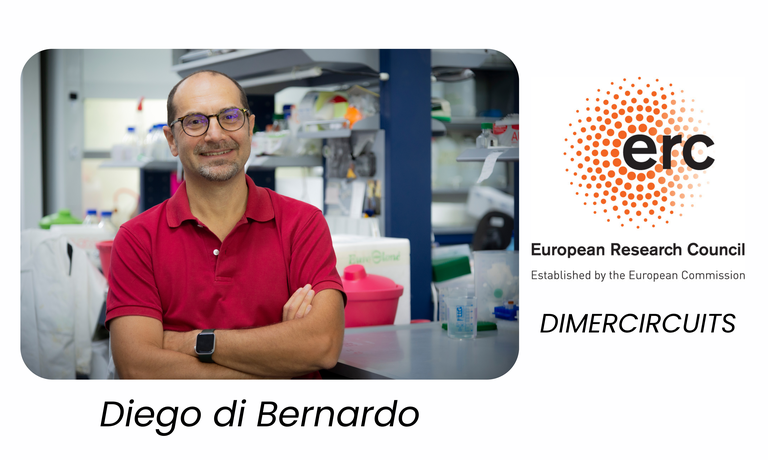
Pozzuoli, Italy — A new chapter in gene therapy is beginning at the intersection of synthetic biology, artificial intelligence, and systems biology. Diego Di Bernardo, Group Leader at the Telethon Institute of Genetics and Medicine (TIGEM) and Professor of Biomedical Engineering at the University of Naples “Federico II”, has been awarded a prestigious ERC Advanced Grant of €2.5 million over five years for his project DIMERCIRCUITS. The goal: to design synthetic genetic circuits that can dynamically, precisely, and reversibly control gene expression — enabling safer and more personalized gene therapies.
Rethinking Gene Control: The DIMERCIRCUITS Vision
Gene therapies often face a critical challenge: how to precisely control gene dosage. Too little, and the therapy is ineffective; too much, and it can be toxic. DIMERCIRCUITS addresses this problem by developing a modular platform based on engineered transcription factors (called MAD-TFs) and their competitive inhibitors (ΔTFs). These components form the building blocks of programmable gene circuits — analogous to electronic circuits but built from DNA and proteins.
These synthetic circuits allow human cells to carry out complex therapeutic tasks, such as adjusting gene activity in response to internal or external cues. But until now, the field has lacked the molecular flexibility needed to make this vision clinically viable. Di Bernardo’s project brings a new generation of compact, tunable, and reversible components to the table — ideal for use in gene therapy vectors.
From System Thinking to Therapeutic Engineering
To understand the true innovation behind DIMERCIRCUITS, we must look at the legacy of systems biology — an interdisciplinary field that aims to understand biological complexity through the integration of experimental and computational methods.
While classical biology often sought to isolate individual genes or proteins, systems biology takes a holistic approach, viewing cells and organisms as dynamic networks of interacting components. The intellectual roots of this perspective stretch back to the 1930s with Ludwig von Bertalanffy’s General Systems Theory and were formalized in the 1960s by Mihajlo Mesarović. However, it wasn’t until the early 2000s — after the Human Genome Project — that systems biology gained traction as a field, thanks to figures like Leroy Hood, who emphasized the importance of data integration, modeling, and technological innovation.
Today, systems biology plays a vital role in understanding how molecular circuits behave in context, and in predicting their response to perturbations. In DIMERCIRCUITS, these principles are being applied not just to study disease — but to design tools that can treat it.
Translating Theory into Practice: Focus on Friedreich’s Ataxia
A translational application of the project will be the development of a gene therapy for Friedreich’s ataxia, a rare neurodegenerative disorder caused by insufficient expression of the frataxin gene. In collaboration with Vania Broccoli’s lab at San Raffaele Hospital in Milan, Di Bernardo’s team will test the therapeutic function of the gene circuits in patient-derived organoids — miniaturized, lab-grown models of human brain tissue.
Organoids bridge the gap between traditional in vitro studies and animal models, offering a more physiologically relevant system in which to assess both the safety and functionality of synthetic genetic tools. They also enable a personalized approach: circuits can be optimized for the specific cellular environment of individual patients.
This work exemplifies translational systems biology: the use of computational models and predictive algorithms to inform the design of biological therapies, with direct application to human disease.
A Multidisciplinary Ecosystem for Innovation: TIGEM’s Unique RoleOne of the critical enablers of this project is the multidisciplinary environment at TIGEM, where cell biology, computational modeling, high-throughput screening, gene therapy, and clinical science converge under one roof. This unique ecosystem fosters cross-talk between disciplines, enabling researchers to explore bold hypotheses and translate them into concrete applications.
Rare genetic diseases — often neglected in mainstream drug development — serve at TIGEM not only as urgent medical challenges but also as entry points for technological innovation. With this latest achievement, TIGEM researchers have now secured a total of 18 ERC grants — a testament to the institute’s outstanding research quality and scientific excellence
Their monogenic nature, well-characterized pathophysiology, and clear therapeutic targets make them ideal testbeds for pioneering tools such as synthetic gene circuits. Once validated in this context, these tools can then be adapted to more complex diseases.
This model — using rare disease research to seed platform technologies — exemplifies TIGEM’s strategic vision and is key to its long-standing scientific impact.
Computational Design Meets Clinical Impact
Another key innovation in DIMERCIRCUITS is the use of artificial intelligence to guide circuit design. By simulating different configurations and behaviors in silico before moving to experimental validation, the team can rapidly iterate and identify the most effective strategies. This integration of model-driven engineering and experimental biology dramatically increases the efficiency and precision of therapeutic development.
The result is not just a scientific proof of concept, but a robust platform technology that could be adapted to many rare diseases — especially those where controlling gene dosage is critical.
Looking Ahead: A Smarter Future for Gene Therapy
DIMERCIRCUITS is more than a research project — it represents a paradigm shift in how we think about gene therapy. By creating intelligent genetic circuits rooted in decades of systems biology and powered by modern AI, Diego Di Bernardo and his team are laying the foundation for a new generation of customizable, safe, and effective treatments.
This work illustrates how rare genetic diseases, once studied only to understand basic biology, are now at the forefront of innovation. These conditions offer unique insights into cellular systems and serve as testbeds for technologies that could eventually benefit a much broader range of patients.
In this way, the legacy of systems biology — once seen as theoretical and abstract — is being translated into real-world therapies, redefining what is possible in precision medicine.