ANDREA BALLABIO RECEIVES THE “BETH LEVINE PRIZE IN AUTOPHAGY RESEARCH” FROM UT SOUTHWESTERN MEDICAL CENTER IN DALLAS
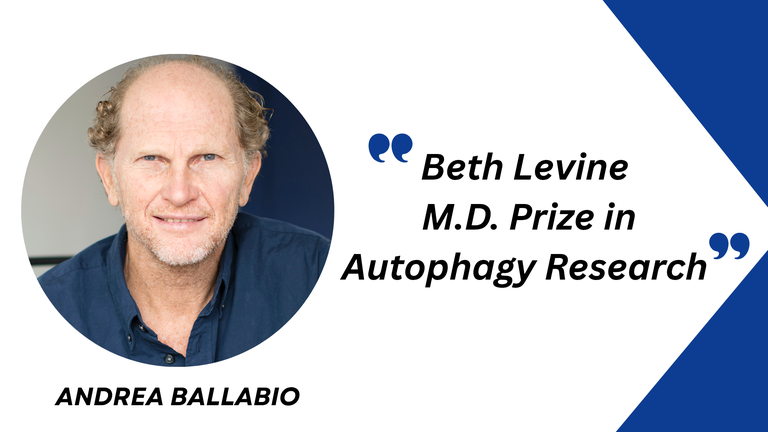
Named after the recently deceased scientist who discovered the first gene involved in mammalian autophagy, the prize recognizes Ballabio’s contributions to understanding the mechanisms behind cellular waste disposal
Naples, June 17, 2025 – The University of Texas Southwestern Medical Center has awarded the Beth Levine Prize in Autophagy Research to Andrea Ballabio, founder and former director of the Telethon Institute of Genetics and Medicine (TIGEM) in Pozzuoli, and Professor of Medical Genetics at the University of Naples Federico II. The award, which includes a $20,000 prize, honors his groundbreaking discoveries on the cellular mechanisms of autophagy and lysosomes, which are fundamental to understanding and treating many rare genetic, neurodegenerative, and cancer-related diseases.
The prize is named in memory of Beth Levine, an internationally renowned American scientist who passed away in 2020 and was known for discovering the first mammalian gene involved in autophagy: the process by which cells degrade and recycle damaged components to maintain health. Levine was a key figure in the scientific community and a source of great inspiration for Ballabio, with whom she shared not only a research focus but also a strong mutual respect and a personal connection formed at numerous international conferences. It was at one such event in Japan—also attended by Yoshinori Ohsumi (later awarded the 2016 Nobel Prize in Medicine for his pioneering work on autophagy)—that Levine suggested Ballabio co-found CASMA Therapeutics, a biotech company dedicated to developing innovative therapies by modulating this essential biological process.
The award was presented on a particularly symbolic date: June 16, the day Beth Levine passed away in 2020 after a long illness.
"Beth was a brilliant and determined scientist who continued working even during the most difficult times—I still remember when she fell ill one night during a conference in Italy and we had to rush her to a small hospital in the mountains of Tuscany. She was very weak, but never gave up her commitment to science. It’s an honor to receive an award that bears her name," said Ballabio.
Ballabio's scientific career has always focused on lysosomal storage disorders, progressive genetic diseases that particularly affect the central nervous system and cause severe disabilities in children. Early in his career, lysosomes were thought of simply as the cell’s “garbage cans”: Ballabio revolutionized this view by demonstrating that lysosomes are dynamic stations that control cellular metabolism, capable of adapting their functions in response to environmental conditions.
In 2009, together with his team, he discovered that the protein TFEB (Transcription Factor EB) is a “master gene” that regulates the coordinated expression of hundreds of genes involved in lysosomal function and autophagy. TFEB not only stimulates the production of lysosomes and autophagosomes (the organelles that deliver cellular waste to lysosomes) but also responds to metabolic signals through interaction with mTOR, another protein complex that regulates the balance between anabolism and catabolism. Under nutrient-rich conditions, mTOR inhibits TFEB; under starvation or stress, TFEB is activated and promotes autophagy.
These discoveries have had a profound impact on cell biology and now underpin numerous applied research programs. The lysosome-autophagy system is involved in over 50 rare genetic diseases, as well as more common conditions such as Alzheimer’s, Parkinson’s, and certain cancers, where the system may become overactive or underactive. Ballabio’s lab, along with several biotech companies (including CASMA Therapeutics), is working to develop pharmacological strategies to modulate TFEB activity in a controlled way—aiming to activate or inhibit the system only when needed, thereby minimizing side effects.
"We are still in the preclinical phase, but results in animal models are promising. The goal is to create precise therapies capable of turning the autophagy system on or off like a switch," Ballabio explained. "Our dream is that one day we will be able to treat devastating diseases by activating a natural process that, in certain pathological conditions, becomes dysfunctional. None of this would have been possible without the constant support of Fondazione Telethon and the amazing young researchers who have worked with me over the years. Thanks to their intelligence, enthusiasm, and dedication, we’ve made exciting and revolutionary scientific discoveries."
UT Southwestern established the Beth Levine Prize in Autophagy Research in 2023 to honor Dr. Levine’s scientific legacy. A member of the National Academy of Sciences and a scientist at the Howard Hughes Medical Institute, Levine was one of the world’s leading experts in the field. Now in its second edition, the prize is awarded every two years to researchers like Ballabio who have made significant contributions to understanding autophagy and its implications for human health.